Categories
Recent Post
Stainless Steel Fasteners
25
Jun 2026
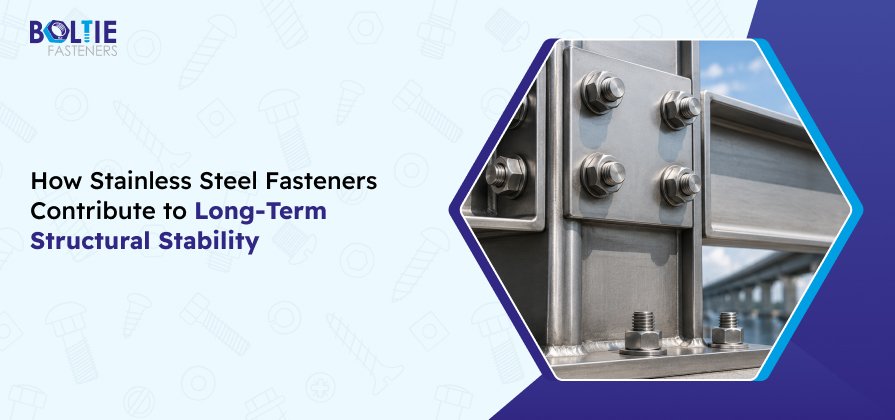
How Stainless Steel Fasteners Contribute to Long-Term Structural Stability
Stainless Steel fasteners are the small parts that hold up big structures, and most people never notice them until something fails. A bridge, a factory roof, or even a metal cabinet depends on bolts and nuts that can hold their grip for years without rusting or loosening.
When a building or machine lasts for decades, it usually means thousands of tiny connection points are doing their job quietly.
In this article, we will look at why Stainless Steel fasteners matter for long-term stability, the science behind their strength, and how to choose a manufacturer you can trust.
Why Choose Stainless Steel Fasteners?
Choosing the right fastener might seem like a small decision, but it shapes how long your entire structure or product actually lasts.
What are SS fasteners?
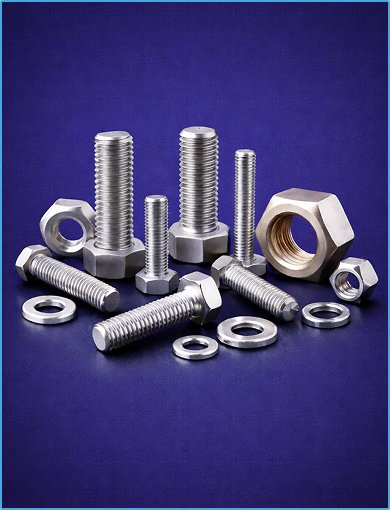
SS fasteners are bolts, nuts, screws, and washers made from stainless steel instead of regular carbon steel. A thin, invisible layer forms on the surface of the metal, which protects it from rust.
These fasteners are used everywhere, from kitchen appliances to bridges, ships, and chemical plants. Their basic job is simple: hold parts together tightly. But Stainless Steel fasteners do this job for far longer than ordinary hardware, even in moisture, chemicals, or extreme weather.
Unique engineering properties of stainless steel
Stainless steel combines strength, flexibility, and resistance to damage. It does not turn brittle in cold weather, and it holds up well under constant heat. It bends slightly under stress without snapping, which matters in structures facing wind, vibration, or heavy loads.
It also keeps its surface quality for years, which is why Stainless Steel fasteners are chosen for projects where performance and appearance both matter.
Why standard carbon steel fails under pressure
Carbon steel fasteners are cheaper, but without a protective layer, they react with moisture and start rusting quickly. Once rust begins, it eats into the metal from the inside, shrinking the bolt and weakening its grip until it eventually fails under load. This is especially risky near coastlines or inside chemical and food processing plants, where carbon steel simply cannot keep up.
Choosing the right alloy grade (204, 304, 316)
Not all stainless steel is equal. Grade 204 suits indoor or low-corrosion settings but offers less protection in harsh conditions.
Grade 304 is the most common choice, balancing strength, cost, and corrosion resistance for general industrial and construction work.
Grade 316 adds molybdenum for superior resistance to salt and chlorides, making it ideal for marine and coastal projects. Picking the right grade of Stainless Steel fasteners for the actual environment is one of the smartest decisions a buyer can make.
How Much Could the Right Nut & Bolt Manufacturer Save You? Read blog on: How the Right Nut & Bolt Manufacturer Reduced Maintenance Costs by 40%
How Fasteners Ensure Long-Term Stability
How chromium stops rust and corrosion
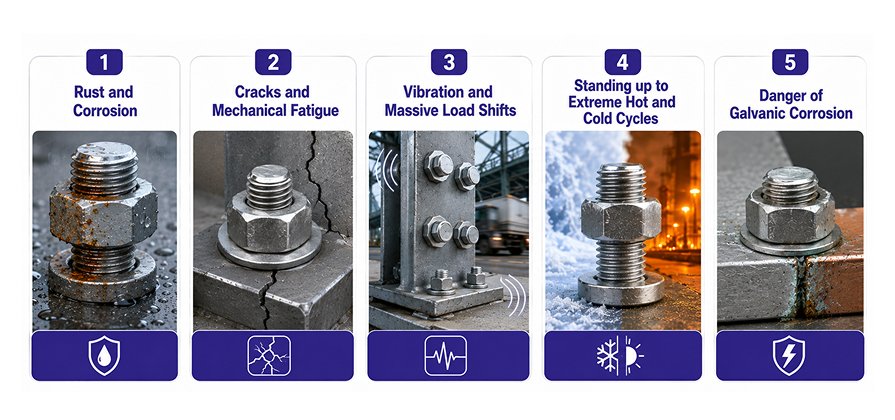
The real secret behind stainless steel’s long life is chromium. Every grade contains enough chromium to react with oxygen and form a thin passive layer on the surface that blocks rust from reaching the steel underneath.
If the surface gets scratched, this layer repairs itself almost instantly. This self-healing ability is why Stainless Steel fasteners stay rust-free for years while ordinary hardware corrodes within months.
This is not just a small efficiency gain; it is a national-scale problem. According to Abhyuday Jindal, Managing Director of Jindal Stainless, corrosion causes economic losses of over $100 billion every year in India alone, and a large share of these losses can be avoided through better material selection and corrosion management practices. When a business chooses corrosion-resistant materials like stainless steel for its fasteners and components, it is directly contributing to reducing this kind of preventable, long-term economic damage.
Resisting stress cracks and mechanical fatigue
Buildings sway in the wind, machines vibrate, and bridges flex under traffic. Over time, this repeated movement can crack weaker metals, a problem called fatigue.
Stainless steel resists this thanks to its strong internal grain structure, which matters most for industrial fasteners used in automotive manufacturing, heavy machinery, and infrastructure, where one failed bolt can cause costly downtime.
Handling vibration and massive load shifts
If a fastener loosens even slightly, that small gap can grow, leading to more wear and eventual failure. Stainless steel’s grip helps fasteners stay tightly seated even under repeated vibration or sudden load shifts, such as during an earthquake or machine startup. Many projects pair this with locking washers for extra protection, but the bolt’s base strength still comes from the steel itself.
Standing up to extreme hot and cold cycles
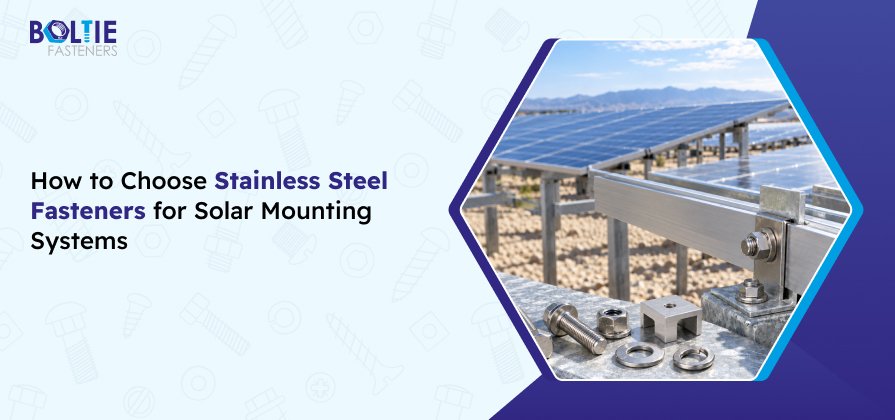
Daily temperature swings cause metal to expand and contract, stressing every joint. Stainless steel handles this far better than ordinary steel because it does not turn brittle in the cold or weaken quickly in heat, making it dependable for rooftops, solar mounting, cold storage units, and outdoor equipment.
Stopping the hidden danger of galvanic corrosion
Galvanic corrosion happens when two different metals touch in the presence of moisture, causing one to corrode faster due to the electrical reaction between them. Even a high-quality fastener can suffer if paired with the wrong metal.
Engineers avoid this with compatible materials, insulating washers, or the right stainless steel grade for nearby metals.
Looking for Reliable Fasteners for Marine Environments? Read our blog on: Why Marine Projects Depend on Stainless Steel Bolts
Finding a Quality SS Nut Bolt Manufacturer
Why material testing and traceability matter
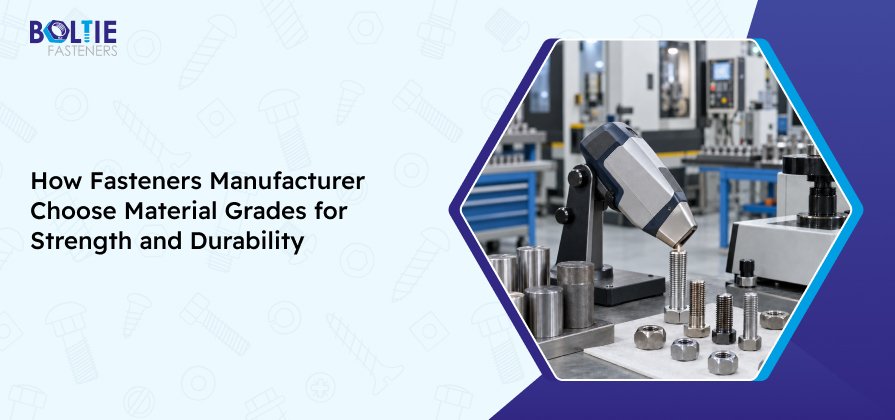
A reliable nut & bolt manufacturer tests raw material batches before production, checking composition, hardness, and tensile strength. Traceability means every batch can be traced back to its source and test reports, which separates a serious fasteners manufacturer from one simply assembling parts without proper checks.
Verifying international standards (ISO, ASTM)
ISO and ASTM standards define exact requirements for material composition, dimensions, and load capacity. A fastener meeting these standards has already passed strict checks. Working with a fasteners manufacturer that follows ISO and ASTM gives buyers confidence that the product will perform as promised in real conditions, not just on paper.
The high cost of low-grade or counterfeit hardware
Counterfeit fasteners often look identical to genuine Stainless Steel fasteners but use cheaper materials or skip heat treatment. The real cost shows up later as premature rusting, loosened joints, or sudden failure, leading to expensive repairs. Saving a little upfront on cheap hardware can cost far more later.
Buyer’s Checklist: 5 Quality Checks for Your Fasteners Manufacturer
Before finalizing a supplier, ask for material test certificates, confirm the exact stainless steel grade, check for ISO or ASTM compliance, ask about in-house testing labs, and review their track record in similar industries.
A trustworthy SS nut bolt manufacturer, whether a small workshop or a large Nut & Bolt Manufacturer with export capabilities, should answer all five clearly.
Global Solutions by Boltie Fasteners PVT LTD
Boltie Fasteners PVT LTD is a stainless steel fasteners manufacturer based in Gujarat, India, with our head office in Surendranagar and a marketing office in Ahmedabad. Since 2016, we have grown into a trusted name for businesses across India and abroad that need dependable hardware.
Whether you are building a chemical plant, a defense facility, or a large construction project, we know that the smallest component, the fastener, can make the biggest difference to how long your structure lasts.
A trusted SS nut bolt manufacturer and global fasteners exporter
We have built our reputation as a dependable nut & bolt manufacturer by focusing on consistent quality across every order. As a fast-growing fasteners exporter, Boltie Fasteners PVT LTD supplies industrial fasteners to clients across pharmaceutical, defense, electronics, construction, and chemical industries, with a product range covering stainless steel bolts, nuts, screws, and washers in a wide variety of DIN standards.
Our strict quality control and advanced testing labs
Every batch of Stainless Steel fasteners that leaves our facility goes through strict quality checks. We use advanced machinery and in-house testing to verify composition, strength, and finish before delivery. This is how we maintain consistency across bulk orders, whether you order ten pieces or ten thousand.
Custom-engineered stainless steel fasteners for complex builds
Not every project fits a standard catalog size. We work closely with engineers and procurement teams to design ss fasteners suited to specific load requirements, dimensions, and standards, from anti-theft bolts to threaded rods, for both standard and custom industrial builds.
Why top engineers partner with Boltie Fasteners PVT LTD
Engineers and procurement managers work with us because we combine technical reliability with dependable service, backed by advanced machinery, bulk order capacity, and on-time delivery.
As a company built on craftsmanship since 2016, Boltie Fasteners PVT LTD aims to be a long-term partner, not just a supplier. If your project needs reliable Stainless Steel fasteners backed by real engineering support, we are ready to help.
Conclusion: Build for the Future
Long-term structural stability is built with the right materials and the right partners, not guesswork. Stainless Steel fasteners quietly hold together everything from small machines to massive infrastructure, year after year.
Choosing the correct grade, understanding corrosion resistance, and working with a manufacturer that takes quality control seriously can save businesses from costly failures later. Investing in dependable fasteners today is really an investment in tomorrow’s safety and longevity.
FAQs:
1. What makes stainless steel fasteners better for structural stability than regular fasteners?
Ans: Stainless steel fasteners resist corrosion, maintain clamping force over time, and withstand extreme loads – making them far more reliable for long-term structural stability than standard fasteners.
2. Which grade of stainless steel bolts is best for structural applications?
Ans: Grade 304 suits general structural use, while Grade 316 stainless steel bolts are preferred for marine, coastal, or chemically exposed environments due to superior corrosion resistance.
3. Is SS Grade 204 suitable for structural applications?
Ans: SS Grade 204 fasteners offer moderate corrosion resistance and good strength, making them suitable for light structural applications in low-humidity, non-marine indoor environments.
4. Can stainless steel bolts and nuts handle high load-bearing applications?
Ans: Stainless steel fasteners resist corrosion, maintain clamping force over time, and withstand extreme loads – making them far more reliable for long-term structural stability than standard fasteners.
5. What makes stainless steel fasteners better for structural stability than regular fasteners?
Ans: Stainless steel fasteners resist corrosion, maintain clamping force over time, and withstand extreme loads – making them far more reliable for long-term structural stability than standard fasteners.