Categories
Recent Post
Stainless Steel Bolts
24
Aug 2026
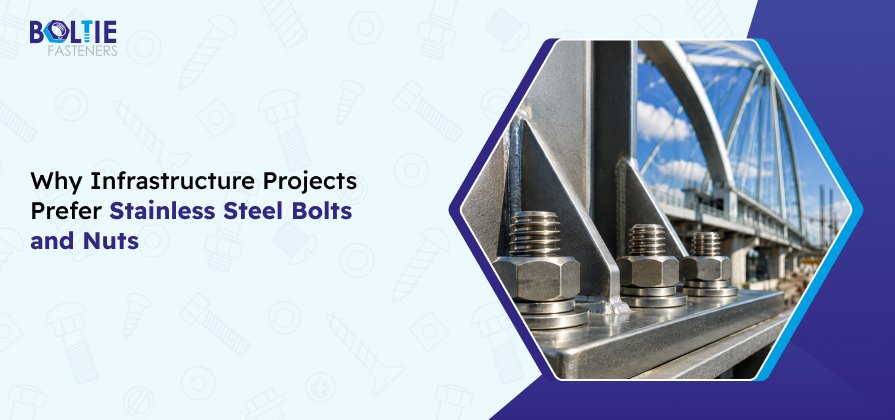
Why Infrastructure Projects Prefer Stainless Steel Bolts and Nuts
Walk past any bridge, tunnel, or coastal power plant and you probably won’t notice the small metal parts holding everything together. But Stainless Steel bolts and nuts are doing quiet, heavy work every single day, gripping steel beams, ducts, and support structures against wind, rain, salt spray, and constant vibration.
Engineers working on bridges, ports, wind farms, and water treatment plants keep coming back to the same choice, because nothing else balances strength, corrosion resistance, and long-term cost quite like stainless steel fasteners.
4 Reasons Engineers Prefer Stainless Steel Bolts and Nuts
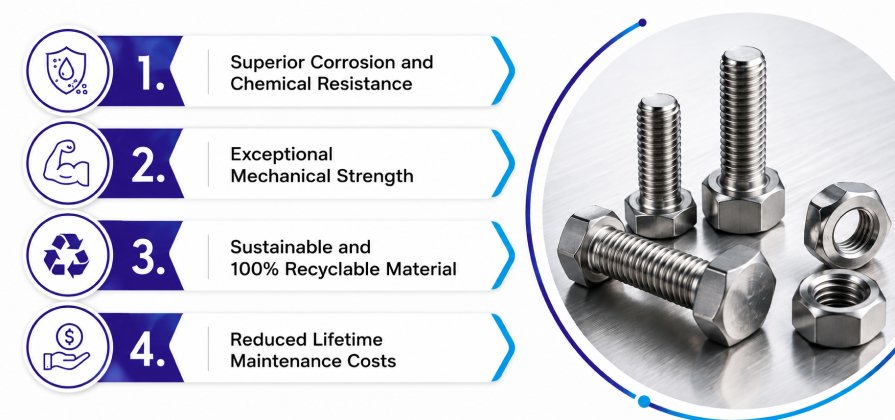
1. Superior Corrosion and Chemical Resistance
Infrastructure sits outdoors, exposed to rain, humidity, salt spray, and sometimes harsh chemicals. Ordinary carbon steel bolts start rusting within a few years under these conditions, and a rusted bolt loses grip strength fast.
Stainless steel bolts and nuts contain chromium, which forms a thin protective layer on the surface that resists rust even in wet or salty environments. That’s why a Stainless Steel bolt and nut is the default choice for everything from highway guardrails to offshore rigs.
2. Exceptional Mechanical Strength
Bridges flex, trains vibrate, and wind turbines sway. Fasteners need to hold their grip through constant movement and shifting loads.
High-grade stainless steel offers strong tensile and yield properties, so a properly rated nut bolt combination keeps its clamping force even after years of repeated stress cycles.
3. Sustainable and 100% Recyclable Material
Stainless steel can be recycled repeatedly without losing its mechanical properties, which matters more each year as projects face pressure to cut their environmental footprint.
Choosing a Stainless Steel nut or bolt over a coated carbon-steel alternative also means less material waste over time, since fewer replacements are ever needed.
4. Reduced Lifetime Maintenance Costs
Replacing corroded fasteners on a bridge or rail line isn’t cheap. It often means shutting down access, hiring specialized crews, and inspecting the surrounding structure for damage.
Because stainless steel bolts and nuts resist corrosion for decades, infrastructure teams spend far less on repeat inspection, maintenance, and replacement work over a project’s lifetime.
Want to know which industries heavily rely on stainless steel fasteners? Read on: 10 Industries That Rely on Stainless Steel Fasteners Every Day
Proprietary Field Data: 50-Year Life Cycle Cost (LCC) Comparison
Upfront price alone doesn’t tell the real story. When we model total cost over a typical 50-year bridge design life, factoring in material cost, inspection cycles, replacement labor, and access or downtime costs, Grade 316 stainless steel pulls well ahead of hot-dip galvanized carbon steel:
| Cost Factor (50-Year Bridge Lifespan) | Hot-Dip Galvanized Carbon Steel | 316 Stainless Steel Bolts and Nuts |
| Upfront material cost | Baseline | 30%-40% higher |
| Typical replacement cycle | Every 15-20 years | None required within design life |
| Inspection and access cost over 50 years | High (repeated crew mobilization) | Low (routine visual checks only) |
| Corrosion-related labor over 50 years | High | Minimal |
| Estimated total maintenance and labor savings | – | Up to 65% lower |
SS Fastener Grade Selection Guide for Construction
Which stainless steel grade is best for construction bolts and nuts?
Not all stainless steel is the same, and picking the wrong grade can be costly. The right choice depends mostly on where the fastener sits and what it will be exposed to.
Grade 304 (A2): Ideal for General Inland Building
For most inland buildings, offices, and everyday commercial jobs, Grade 304 does the job just fine. It shrugs off normal rain and humidity without any trouble, and it costs less than the fancier grades, which is why you’ll see it specified on the vast majority of standard structural work.
Grade 316 (A4): Essential for Marine and Coastal Projects
Anything near the coast is a different story. The molybdenum in Grade 316 gives it real resistance to chloride, which is what saltwater throws at a structure day after day. Skip this grade on a coastal bridge or a port and you’re basically inviting pitting corrosion.
So it’s no surprise engineers reach for Grade 316 stainless steel bolts and nuts almost by default whenever seawater is in the picture.
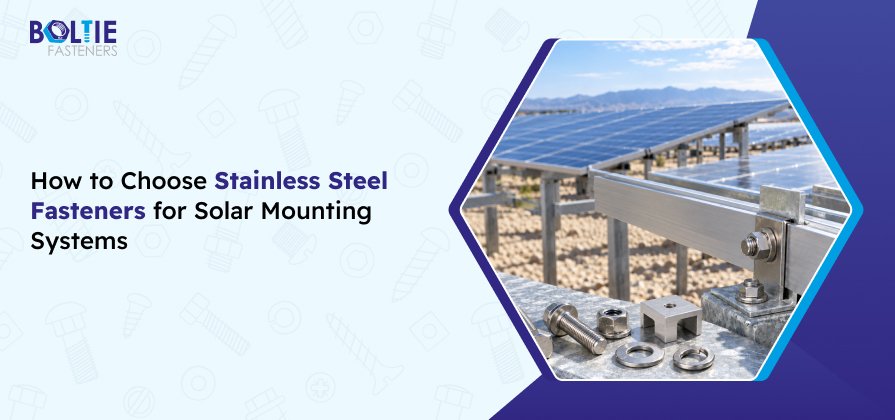
Also read on: Stainless Steel Fasteners for Solar Panels
Types of Fasteners Used Across Key Infrastructure Sectors
Bridges and Highways: Heavy-Duty Hex Bolts and Nuts
On bridges, it’s large hex bolts and matching nuts doing the heavy lifting, holding the steel girders and expansion joints together under loads that never really let up.
Coastal Engineering: High-Corrosion Studs and Heavy Nuts
Ports, jetties, seawalls get marine-grade studs and heavy hex nuts, and Grade 316 shows up here more often than not, simply because there’s no getting away from the saltwater spray.
Water and Energy Plants: Anchor Bolts and Threaded Rods
Inside a treatment plant or a power station, you’re usually looking at anchor bolts and threaded rods bolting heavy equipment down to the concrete, often with chemical exposure and vibration working against the fastener at the same time.
Rail, Tunnels, and Transit Systems: Anti-Vibration Lock Nuts and Washers
Rail lines and tunnels have their own headache: vibration that never stops. That’s exactly why anti-vibration lock nuts and washers are the standard here. A regular nut will work itself loose eventually, and that’s not something you want to find out the hard way on a rail line.
Key Global Quality Standards for SS Fasteners
International Standards for SS Fasteners
ASTM A193 / A194
These American standards cover bolting materials for high-temperature and high-pressure service, commonly referenced for stainless steel bolts and nuts used in energy and industrial plants.
ISO 3506-1 & 3506-2
This international standard sets mechanical property requirements for stainless steel fasteners used in general construction and industrial applications worldwide.
DIN 931 / DIN 933
These German standards define dimensions for hex head bolts, both half-threaded and fully threaded, widely used across construction and manufacturing.
ANSI / ASME B18.2.1
This American standard covers dimensional and thread specifications for hex bolts, ensuring parts from different manufacturers fit together reliably.
Mandatory Quality Testing
Salt Spray Testing (ASTM B117)
This test exposes fasteners to a controlled salt fog to measure how long they resist visible corrosion, a key indicator for coastal and marine use.
Proof Load & Tensile Testing
Fasteners are pulled and loaded to confirm they meet their rated strength before a batch is approved for a project.
Chemical Analysis (PMI Testing)
Positive Material Identification confirms the exact alloy composition of each batch, verifying that a fastener labeled Grade 316, for instance, actually contains the chromium, nickel, and molybdenum levels required.
Boltie Fasteners PVT LTD: A Trusted Partner for High-Performance Stainless Steel Bolts and Nuts
We started Boltie Fasteners PVT LTD back in 2016, out of a facility in Surendranagar, Gujarat, and we’ve been making stainless steel fasteners for the construction, energy, defense, pharmaceutical, and chemical industries ever since.
We won’t pretend we’re the biggest name in the country, but ask anyone who’s worked with us and they’ll tell you the same thing: as a nut & bolt manufacturer, we care more about a part holding up ten years down the line than about winning an order today.
Custom Sizes, Grades, and Advanced Quality Testing
Need Grade 304, Grade 316, or something custom-sized for a one-off application? We can run it. Every batch at Boltie Fasteners PVT LTD goes through salt spray testing, tensile testing, and PMI chemical analysis before it ships, so when a Stainless Steel bolt or a Stainless Steel nut leaves our facility, we already know it does what the spec sheet says.
Get a Custom Quote from Boltie Fasteners PVT LTD Today
If you’re specifying Stainless Steel bolts and nuts for an upcoming project, get in touch through boltiefasteners.com and we’ll work out a quote based on what you actually need.
Conclusion: Building Stronger, Safer Infrastructure for the Future
Nobody notices a fastener until it fails. That’s really the whole point. The right grade, tested against the right standard, from a manufacturer who stands behind it, is what lets a bridge or a coastal plant quietly do its job for fifty years. Getting the choice of Stainless Steel bolts and nuts right at the start is a small decision that pays off for decades.
FAQs:
1. Why are stainless steel bolts and nuts used in infrastructure projects?
Stainless steel bolts and nuts provide excellent corrosion resistance, mechanical strength, durability, and reliable performance in demanding infrastructure and outdoor environments.
2. Do stainless steel bolts and nuts rust over time?
Stainless steel bolts and nuts are highly resistant to rust, but their corrosion resistance depends on the stainless steel grade and environmental conditions.
3. Which stainless steel grade is best for infrastructure applications?
Grade 304 is widely used for general infrastructure applications, while 316 stainless steel is preferred where higher corrosion resistance is required.
4. What should you consider when choosing stainless steel bolts for infrastructure?
Yes, certain grades maintain structural integrity and resist oxidation at elevated temperatures, making them suitable for industrial furnaces, exhaust systems, and power plant equipment.
5. Why are stainless steel bolts preferred for long-term infrastructure projects?
Stainless steel bolts are preferred because they combine corrosion resistance, durability, strength, and long service life, making them suitable for infrastructure exposed to demanding conditions.