Categories
Recent Post
Stainless Steel Bolts
16
Jul 2026
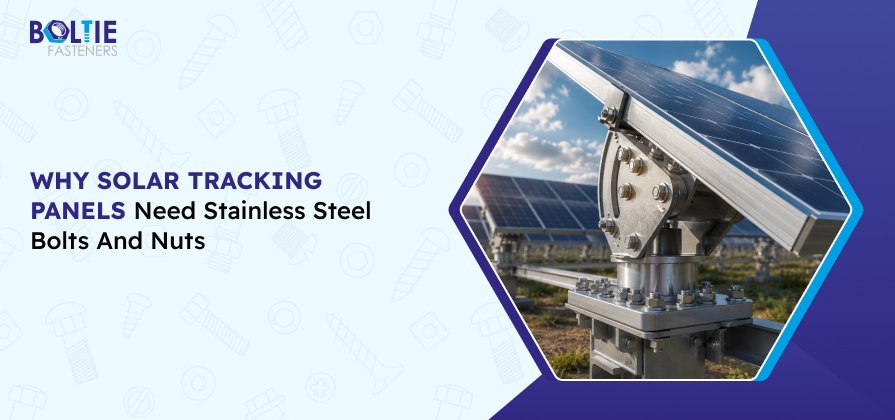
Why Solar Tracking Panels Need Stainless Steel Bolts and Nuts
Solar tracking systems are always moving, and that constant motion puts real stress on every joint in the structure. This is exactly why Stainless Steel Bolts and Nuts comes into the category of high quality fasteners for solar trackers instead of regular hardware.
A solar tracker is only as strong as the fasteners holding it together, and when those fasteners are cheap or of the wrong grade, the whole system suffers.
In this blog, we will walk you through why ordinary hardware fails outdoors, why moving parts need something tougher, and how the right stainless steel fastener protects your solar investment for decades.
Why Normal Fasteners Fail on Solar Tracking Systems
Solar trackers are installed outdoors, in open fields, often in regions with harsh sun, heavy rain, or salty coastal air. Regular mild steel or zinc-coated fasteners were never built for this kind of continuous exposure, and this is exactly where they fall short of real solar tracker hardware requirements, which is where the trouble starts.
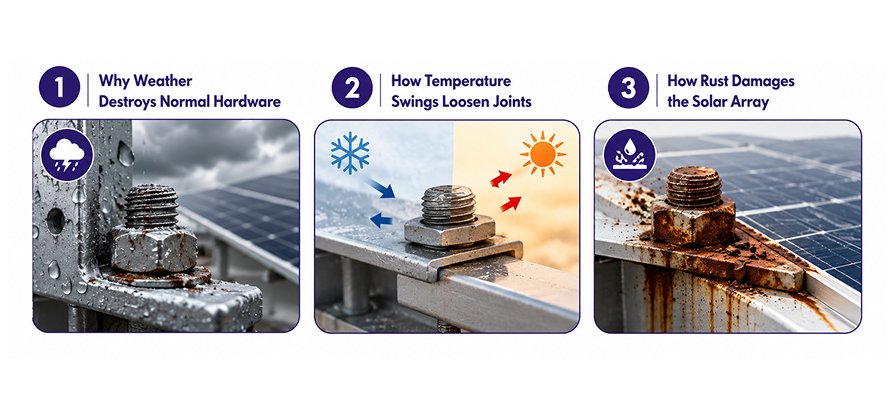
Why Weather Destroys Normal Hardware
Rain, humidity, dust, and UV exposure attack ordinary fasteners every single day. A zinc coating on a normal bolt wears off within a year or two under constant sun and rain, and once that coating is gone, the bare metal underneath starts corroding.
On a solar farm with thousands of connection points, even a small failure rate becomes a big maintenance headache, which is exactly the failure point that quality Stainless Steel Bolts and Nuts are designed to eliminate.
How Temperature Swings Loosen Joints
Solar panels sit in direct sunlight all day and then cool down at night, and this daily heating and cooling cycle causes metal to expand and contract. Normal fasteners are not designed to handle this repeated thermal cycling, so joints slowly loosen over time.
A loose bolt on a tracking arm is not just an inconvenience; it can lead to panel misalignment and reduced energy output.
Also read our detailed guide on: How Stainless Steel Fasteners Contribute to Long-Term Structural Stability
How Rust Damages the Solar Array
Once rust sets in, it does not stay in one place. Rust stains spread onto panel frames, mounting structures, and nearby components, damaging both the appearance and the structural strength of the array.
In advanced cases, rust can seize a nut onto a bolt so tightly that technicians have to cut it off during maintenance, which adds unnecessary cost and downtime for any solar project.
Why Mechanical Motion Demands Stainless Steel Fasteners?
Unlike fixed rooftop solar panels, tracking systems physically rotate to follow the sun from east to west. That mechanical motion changes everything about how a fastener needs to perform.
Managing Dynamic Loads and Constant Movement
Every rotation of a tracker puts dynamic load on the pivot points, gearboxes, and mounting brackets. A Stainless Steel Bolt and Stainless Steel Nut combination is built to absorb this repeated stress without cracking or weakening, which is essential since trackers can move thousands of times over their operating life.
Preventing Thread Galling and Seizure
Thread galling happens when two metal surfaces bind and tear under friction, and it is a common problem with poor-quality fasteners used in moving assemblies. Using the best bolts for solar tracking panels, the correct combination of stainless steel grades, along with proper lubrication during installation, helps prevent galling and keeps nuts and bolts easy to remove even after years of use.
Learn how Fasteners help improve the Structural Strength in Solar Structures, Read on: Stainless Steel Fasteners for Solar Panels
Resisting Vibration and Maintaining Clamp Load
Wind, motor vibration, and constant rotation can shake a joint loose if the fastener cannot hold its clamp load. Quality Stainless Steel Bolts and Nuts, especially when paired with proper washers, keep their grip and resist vibration-induced loosening far better than standard hardware.
Corrosion Resistance of the Stainless Steel Nut and Bolt
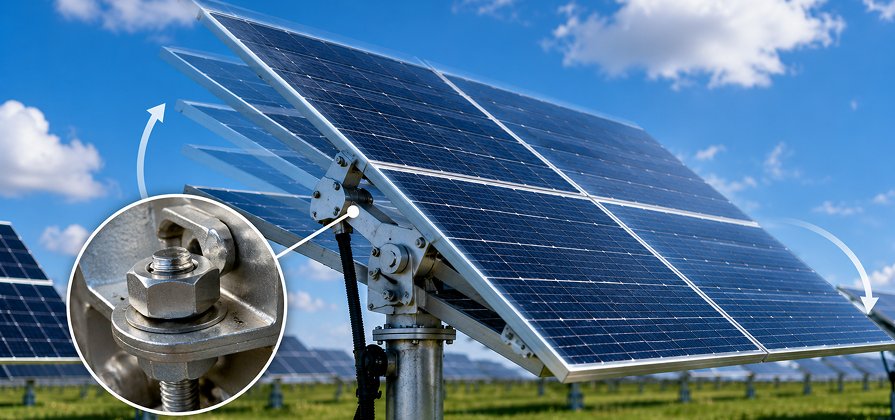
Corrosion resistance is the main reason Stainless Steel Bolts and Nuts are the top choice for solar tracker hardware. Its reason comes down to simple material science.
Understanding Galvanic Corrosion Between Aluminium and Steel
Solar panel frames and tracker rails are usually made of aluminium, and when aluminium touches a dissimilar metal in the presence of moisture, galvanic corrosion can occur.
Choosing the correct stainless steel grade for the fastener, sometimes with an isolating washer, helps prevent this reaction and protects both the fastener and the aluminum frame from premature damage.
Chromium’s Self-Healing Passive Layer
Stainless steel contains chromium, and this chromium reacts with oxygen in the air to form a thin, invisible passive layer on the surface. If this layer is ever scratched, it reforms on its own as long as oxygen is present. This is why a genuine Stainless Steel Nut or bolt keeps resisting rust year after year instead of relying on a coating that wears off.
Choosing the Right Grade: Stainless Steel 204, 304, and 316
Not all stainless steel is the same. Grade 204 offers reasonable corrosion resistance at a lower cost, grade 304 is the most common choice for general outdoor use, and grade 316 adds molybdenum for superior resistance in coastal or highly corrosive environments.
For solar trackers, tensile classifications like A2 and A4 are also commonly referenced, with A2 typically corresponding to 304-grade material and A4 corresponding to 316-grade material for higher strength and corrosion demands. Matching the grade to the site conditions is one of the most important decisions in any Utility-Scale PV Asset design.
Long-Term ROI of Premium SS Fasteners
Choosing quality Stainless Steel Bolts and Nuts is not an added expense, it is an investment decision that pays off across the entire O&M lifecycle of the project.
Upfront Costs vs. Lifetime Value
A premium Stainless Steel Nut and Bolt costs more at the time of purchase compared to standard hardware, but the lifetime value tells a different story. Fewer replacements, fewer site visits, and a longer service life mean the higher upfront cost is recovered many times over during the 25-plus-year life of a typical solar asset.
Reducing Maintenance Overhead
Every unplanned maintenance visit to a solar farm costs time, labor, and lost energy generation. Reliable SS Fasteners, particularly genuine Stainless Steel Bolts and Nuts, reduce the number of these visits significantly.
This is a great deal to EPC Contractors and asset owners who are managing large, spread-out installations with tight O&M budgets.
Boltie Fasteners PVT LTD: Heavy-Duty Stainless Steel Bolts and Nuts
Boltie Fasteners PVT LTD is a stainless steel fastener manufacturer based in Surendranagar, Gujarat. Since its establishment in 2016, our company has grown into a trusted name for stainless steel fasteners across India, supported by advanced manufacturing machinery and a strong focus on precision.
As a dedicated nut bolt manufacturer, we have built our reputation on consistent quality and dependable supply.
Engineering Precision for the Renewable Energy Sector
The renewable energy sector demands Stainless Steel Bolts and Nuts that can be trusted for decades without inspection failures.
As a specialized nut & bolt manufacturer, Boltie Fasteners PVT LTD’s product range includes hex head bolts, flange bolts, threaded rods, and threaded studs manufactured to international standards such as DIN 933 and DIN 931 for hex bolts and DIN 976 for threaded rods and studs, giving EPC Contractors the documentation and consistency they need for utility-scale projects.
Strict Quality Control and Certified Material Reliability
Every batch that leaves our facility goes through quality checks focused on material grade, dimensional accuracy, and finish, because a single weak fastener in a solar tracker array can compromise an entire row of panels. As one of the reliable bolts & nuts suppliers in the country, Boltie Fasteners PVT LTD stands behind the reliability of every nut bolt we ship.
Scale and Customization for Large-Scale Solar Farms
Large solar farms need bulk quantities delivered on schedule, and our company, as one of the dependable bolts & nuts suppliers and a recognized Nut & Bolt Manufacturer in India, is built for exactly that.
Whether a project needs standard DIN specifications or custom sizes for a specific tracker design, our team can support both small orders and high-volume requirements without compromising on delivery timelines.
Conclusion: Secure Your Solar Investment
Solar tracking systems represent a serious financial commitment, and the fasteners holding them together deserve just as much attention as the panels and motors themselves.
Choosing the correct Stainless Steel Bolts and Nuts protects your project from corrosion, vibration loosening, and thread failure, while keeping maintenance costs low across the full O&M lifecycle.
If you are sourcing fasteners for your next solar tracking project, reach out to Boltie Fasteners PVT LTD to discuss the right grade and specification for your site conditions.
FAQs:
1. Why are stainless steel bolts preferred for solar tracking systems?
Stainless steel bolts resist corrosion, rust, and weather damage far better than standard steel, making them ideal for outdoor solar installations exposed to moisture, humidity, and temperature swings.
2. What grade of stainless steel is best for solar panel fasteners?
SS 304 and SS 316 are the most commonly used grades – SS 316 offers superior corrosion resistance, making it ideal for coastal or high-humidity regions, while SS 304 works well for standard installations.
3. Can regular carbon steel bolts be used instead of stainless steel for solar trackers?
Carbon steel bolts are prone to rust and corrosion over time, which can compromise structural integrity and require frequent replacement – stainless steel offers a longer, low-maintenance lifespan.
4. How do weather conditions affect fastener choice for solar trackers?
Coastal areas, high humidity, and extreme temperature zones demand higher-grade stainless steel (like SS 316) to prevent pitting corrosion and material fatigue.