Categories
Recent Post


Stainless Steel Screws
28
Oct 2026
Why Screw Quality and Dimensional Accuracy Matter in Industrial Manufacturing
Choosing a trusted screw manufacturer is one of the smartest decisions an industrial buyer can make. A screw looks like a tiny part, but a small size error can damage a whole machine or project.
In this blog, we explain why quality and accuracy matter, what makes a good screw, and how to pick the right partner.
Why is dimensional accuracy important in industrial screws?
Dimensional accuracy means a screw matches its stated size, thread, and shape within a very small allowed difference. When it does, the screw fits its mating part every time.
When it does not, the screw may wobble or strip. Assembly lines run on repeatability, so even a small size error can slow down hundreds of units. That is why every serious screw manufacturer treats accuracy as a basic requirement.
How does poor screw quality affect manufacturing efficiency and product safety?
Poor screws slow production because workers stop to re-tighten or replace faulty pieces.
Safety is the bigger concern. A weak or badly threaded screw can loosen under vibration or snap under load, which can lead to breakdowns and injuries. Buying from a dependable screw manufacturer in India reduces this risk from the start.
What Defines a High-Quality Industrial Screw?
A good screw manufacturer focuses on four things: material, threads, finish, and standards.
Material Quality and Strength
The base material decides how much load a screw can carry. SS 204 suits light-duty use, SS 304 works well for general use, and SS 316 adds molybdenum for marine, chemical, and chloride-rich environments.
Thread Precision and Dimensional Accuracy
Clean threads with the right depth and pitch engage smoothly and give steady clamping force.
For example, an M8 coarse thread has a pitch of 1.25 mm, while an M8 fine thread has a pitch of 1.0 mm. They look almost identical, but forcing one into the other damages both. Experienced engineers always check pitch, not just diameter.
Corrosion Resistance and Surface Finish
Stainless steel forms a thin chromium oxide layer that protects it from rust. A passivated or bright passivated finish improves this protection further.
Compliance With DIN, ISO, and Other Industry Standards
A screw made to DIN or ISO has defined dimensions, so parts from different batches still fit together. Always check that the screw follows the standard printed on its datasheet.
How Dimensional Accuracy Affects Screw Performance
Correct Thread Size and Pitch for Secure Fastening
If the thread size or pitch is wrong, the screw will not grip properly and may loosen later. The correct size and pitch give a firm, stable hold.
Accurate Screw Length and Diameter for Proper Fit
Too short, and a screw holds poorly. Too long, and it may hit the bottom of a hole or damage the part behind it. This matters even more for a hex head self drilling screw, where the drill tip and body length must suit the sheet thickness.
Consistent Head Dimensions for Easy Installation
A Hex Head Screw (DIN 933) with an uneven hex can slip under a spanner and round off. In a sems screw, the attached washer must also stay uniform so the load spreads evenly.
Importance of Tight Manufacturing Tolerances
A tolerance is the small amount a size is allowed to vary. Tight tolerances mean every screw in a batch behaves the same way, which is vital for automated lines.
Common Problems Caused by Poor Screw Quality
Loose Connections and Assembly Failures
A screw with poor threads cannot hold its clamping force. Under vibration, the joint loosens and, in the worst case, the assembly fails during use.
Thread Damage and Improper Fastening
Rough threads tear the mating part when tightened, and a damaged thread can never hold fully again. A hex head self drilling screw with a poorly formed tip may also wander or strip the sheet metal.
Increased Machine Downtime and Maintenance Costs
Loose or broken screws cause unplanned stoppages, and every hour spent replacing them costs money.
Product Rejection, Rework, and Production Delays
A badly fitted screw can ruin a finished product. The item is rejected, goes back for rework, and delivery dates slip.
Quality Control Tests Used by a Reliable Screw Manufacturer
A good screw manufacturer relies on proven checks, not guesswork.
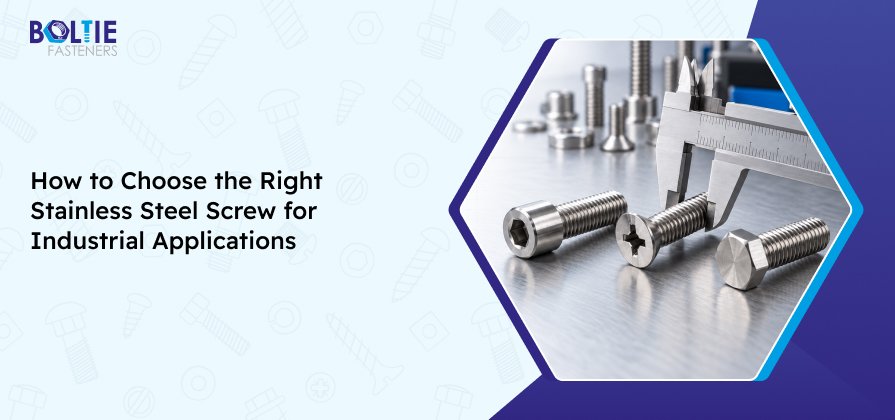
Dimensional Inspection Using Vernier Calipers and Micrometers
Vernier calipers and micrometers measure length, diameter, and head size, including tiny differences the eye cannot see.
Thread Inspection Using Plug and Ring Gauges
A ring gauge checks the thread on a screw, while a plug gauge checks the thread inside a nut or hole. Each gauge has a “go” side that must pass and a “no-go” side that must not.
A careful screw manufacturer tests samples from every batch, not only the first piece off the machine.
Hardness and Tensile Strength Testing
Hardness tests show how well the metal resists wear. Tensile tests show the load a screw can truly carry.
Material Grade Verification and Surface Inspection
Material checks confirm that a screw is really SS 304 or SS 316 and not a cheaper grade. A surface check looks for burrs and scratches.
Choosing the Right Screw Manufacturer for Industrial Applications
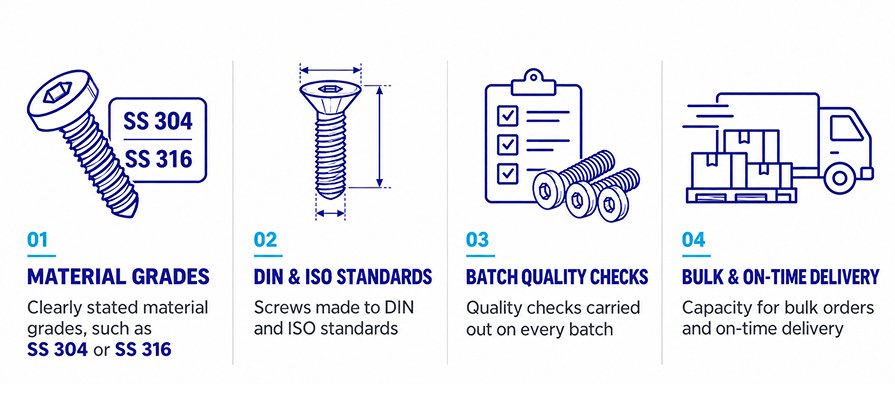
Picking a supplier is about trust as much as price. Here is what to look for:
- Clearly stated material grades, such as SS 304 or SS 316
- Screws made to DIN and ISO standards
- Quality checks carried out on every batch
- Capacity for bulk orders and on-time delivery
A dependable screw supplier will answer these points openly.
How Boltie Fasteners PVT LTD Delivers Quality and Precision in Industrial Screws
Boltie Fasteners PVT LTD (BLF) has been manufacturing stainless steel fasteners since 2016. As a screw manufacturer in India, we make screws, bolts, and nuts for pharmaceutical, defense, electronics, construction, and chemical industries.
Our head office is in GIDC Estate, Surendranagar, Gujarat, with a marketing office in Ahmedabad.
Precision-Manufactured Stainless Steel Screws for Industrial Applications
We make stainless steel screws in SS 204, SS 304, and SS 316. Metric sizes run from M6 to M20, and self-tapping screws from #4 to #14, with passivated or bright passivated finishes.
Advanced Manufacturing and In-House Quality Testing
Boltie Fasteners PVT LTD uses advanced machinery to keep our screws precise and consistent. They are made to tight dimensional tolerances under DIN and ISO standards, giving smooth thread engagement and steady clamping force.
Wide Range of Screws Manufactured to DIN Standards
Our screw range covers many head styles and drives. Some popular products include:
- Hex Head Screw (DIN 933)
- Hex Head Sems Screw (DIN 6900)
- Hex Socket Head Cap Screw (DIN 912)
- CSK Phillip Head Screw (DIN 965)
- Pan Head Machine Screw (DIN 7985)
- Allen CSK Screw (DIN 7991)
You can view the full range on our stainless steel screw page.
Consistent Quality and Reliable Bulk Supply
Industrial projects need the same quality in the thousandth screw as in the first. As a screw manufacturer and screw supplier with the capacity for bulk orders, we deliver consistently and on time across India.
To discuss your requirements, visit boltiefasteners.com or write to info@boltiefasteners.com.
Conclusion: Why Quality and Precision Matter for Long-Term Manufacturing Success
Screw quality and dimensional accuracy decide whether an assembly stays tight for years or fails early.
Choosing a screw manufacturer that treats these points seriously saves time, money, and risk. If you are looking for a screw manufacturer in India you can rely on, Boltie Fasteners PVT LTD is ready to help.
FAQs
1. What is dimensional accuracy in a screw?
It means the screw’s size, thread, and head shape match the stated specification within a very small allowed difference. This lets it fit its mating part properly every time.
2. Why does screw quality matter in industrial manufacturing?
Good screws hold their clamping force under vibration and load. Poor ones loosen, strip, or break, which causes downtime, rework, and safety risks.
3. Which stainless steel grades are used for industrial screws?
The common grades are SS 204 for light-duty use, SS 304 for general use, and SS 316 for marine, chemical, and chloride-rich environments. Boltie Fasteners PVT LTD makes screws in all three grades.
4. How can I check that a screw meets the right standard?
Check that the datasheet lists the DIN or ISO standard, such as DIN 933 or DIN 912. You can also ask the supplier about their batch checks, such as plug and ring gauge inspection and dimensional measurement.