Categories
Recent Post
Stainless Steel Bolts
19
Jun 2026
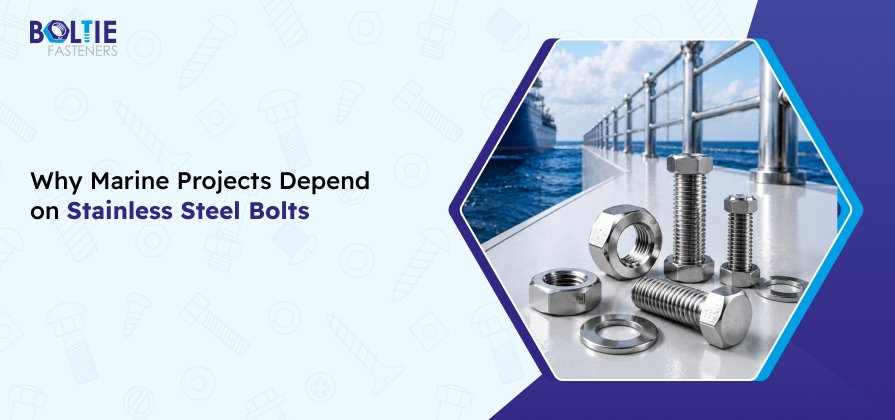
Why Marine Projects Depend on Stainless Steel Bolts
When engineers plan a marine project, whether it is a dock, an Offshore Floating Solar Photovoltaic (OFPV), or an offshore wind farm, one of the first questions they ask is: what fasteners can survive saltwater? The answer, almost every time, is stainless steel bolts.
Saltwater is one of the most aggressive environments any material can face. Regular carbon steel rusts within weeks. Stainless steel, on the other hand, is built to handle it.
This article breaks down exactly why SS bolts are the backbone of marine infrastructure and what you should know before specifying them for your next project.
How Stainless Steel Resists Corrosion
The Role of Chromium and the Protective Passive Layer
Chromium is the element that makes stainless steel durable even in the harshest conditions. Stainless steel containing at least 10.5% chromium reacts with oxygen in the air to form a thin, invisible layer called a passive layer.
This protective film coats the surface and blocks moisture, salt, and other corrosive materials from making contact with the metal underneath.
How Stainless Steel Automatically Heals Surface Damage
One of the biggest advantages of stainless steel is its self-repairing ability. If the passive layer gets scratched or damaged, it reforms on its own in the presence of oxygen.
This is why stainless steel bolts stay intact even in environments where surfaces are constantly abraded by wave action, loading equipment, or marine growth.
Want long-lasting fastening solutions for your solar panel projects? Explore our blog on: Stainless Steel Fasteners for Solar Panels
Preventing Structural Rust Stains and Decay
Rust stains are just as damaging to a project’s lifespan as structural failure. When fasteners corrode, iron oxide spreads into surrounding concrete, fiberglass, and timber, weakening the material and creating expensive repair work.
SS fasteners eliminate this problem at the source, keeping structures cleaner and maintenance costs lower over the long run.
Different Grades of Stainless Steel: SS204, SS304 & SS316
Grade 202/204: The Economical Choice for Mild & Indoor Environments
Grade 202 (SS 204) is a cost-effective 200-series stainless steel widely used in India. It offers good toughness and moderate corrosion resistance, making it suitable for indoor applications, kitchen equipment, dry architectural fittings, and light structural work where exposure to moisture and chemicals is limited. For budget-focused projects, SS 202/204 stainless steel fasteners are a practical and reliable choice.
Grade 304: Best Practices for Low-Salinity Environments
Grade 304 is the go-to choice for freshwater marine settings, indoor pool facilities, and coastal structures that sit far from direct wave exposure. It performs reliably in areas with low chloride levels. It also comes at a more accessible price point.
Grade 316: The Industry Standard for True Marine Applications
Grade 316 contains 2-3% molybdenum, which gives it a strong edge against chloride attack – the primary threat in seawater. For tidal zones, submerged components, or anything in direct spray contact, 316 stainless steel bolts are what experienced marine engineers specify every time.
The 5-Mile Rule: Specifying Hardware by Coastal Proximity
A commonly used guideline in construction and infrastructure projects is the 5-mile rule. For locations within 5 miles of the coastline, 316-grade ss fasteners are recommended due to their superior resistance to saltwater corrosion. For sites beyond 5 miles from the coast, 304-grade fasteners are generally suitable in most environments. In indoor, dry, and low-corrosion applications, 202/204-grade stainless steel fasteners offer a cost-effective alternative where exposure to moisture and chlorides is minimal.
Applications Where Stainless Steel Bolts Safeguard Infrastructure
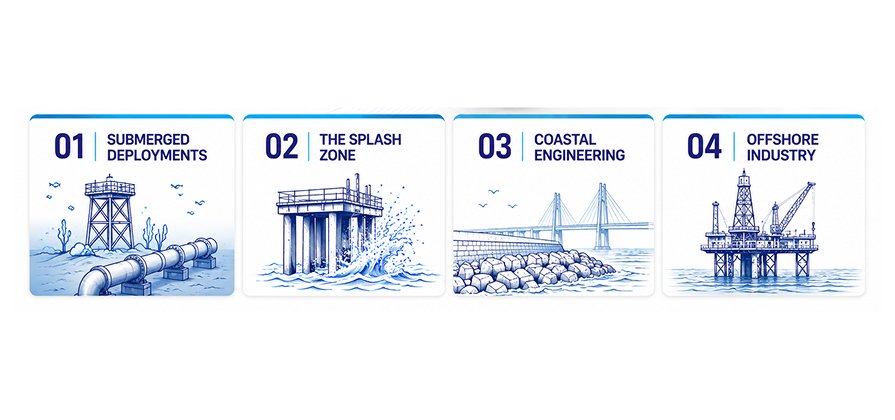
Submerged Deployments: Underwater Hulls and Propulsion Systems
Ship hulls, propeller shafts, and rudder assemblies stay underwater permanently. Stainless steel bolts and other fasteners used here face constant pressure, vibration, and marine biofouling every single day.
The Splash Zone: Managing High Corrosion on Docks and Piers
The splash zone is the area where a structure alternates between wet and dry as waves hit. In reality, such zones are actually more corrosive than full submersion because oxygen-rich water constantly contacts the metal, accelerating chemical reactions. SS bolts handle this cycling stress better than any other commonly available fastener material.
Coastal Engineering: Port Facilities, Bridges, and Highway Assets
Coastal bridges, port cranes, and sea-facing retaining walls are all exposed to salt-laden air. Using stainless steel bolts in these structures extends service life by decades and reduces inspection and replacement costs significantly.
Offshore Industry: Oil Rigs and Marine Wind Turbines
Offshore platforms and wind turbine foundations face some of the harshest conditions on earth. For such conditions, SS fasteners become engineering requirements, rather than just an option. The long-term structural integrity of an offshore installation depends on fasteners that will not fail between maintenance cycles.
How Stainless Steel is driving market growth across Asia? Explore our blog on: Why Demand for SS Fasteners Manufacturers is Surging Across Asian Markets
Common Risky Areas in Marine SS Fasteners Usage
Galvanic Corrosion: The Danger of Mixing Dissimilar Metals
On the Galvanic Series Scale, stainless steel is well known for its resistance to corrosion. When stainless steel bolts, nuts, and screws are assembled with other weaker materials that corrode easily in the presence of an electrolyte like seawater, the weaker metal corrodes rapidly.
That’s why, always match fastener material to the connected components and use insulating washers or coatings where you’re using dissimilar metals.
Thread Galling: Preventing Friction Seizure During Assembly
Thread galling happens when stainless steel threads seize due to friction and pressure during assembly, making the Stainless Steel bolts and other fasteners impossible to remove. Using anti-galling lubricants such as molybdenum disulfide paste and tightening at a controlled torque rate prevents this from happening.
The Misconception that Stainless Steel is 100% Rust-Proof
Stainless steel is corrosion-resistant, but not corrosion-proof. In confined, low-oxygen environments, such as crevices under bolt heads, a phenomenon called crevice corrosion can occur. Proper joint design, correct grade selection, and periodic inspection are necessary to keep SS bolts performing as intended over their full design life.
Premium Engineering Solutions by Boltie Fasteners PVT LTD
At Boltie Fasteners PVT LTD, we manufacture stainless steel bolts and SS fasteners built for environments that push materials to their limit. Based in Gujarat, India, we have spent years refining our processes so that every fastener leaving our facility is one that engineers and project managers can genuinely rely on, not just on paper, but in the field.
Rigorous Quality Control in Our Fastener Manufacturing
As a fasteners manufacturer, consistency is something we take seriously. Every product we ship goes through dimensional inspection, grade verification, and surface quality checks. Whether your order is 500 pieces or 5,00,000, the standard does not change.
Custom Fabrication Services for Large-Scale Offshore Projects
Offshore and marine projects rarely fit standard catalog specifications. As an experienced bolt manufacturer, Boltie Fasteners PVT LTD works directly with engineering teams to produce fasteners with special thread forms, custom dimensions, and high-volume output capacity. Bring us your drawings and project requirements, and we will take it from there.
Industrial Supply, Corporate Procurement, and Technical Support
Boltie Fasteners PVT LTD stay involved well beyond the manufacturing stage. Our team helps engineers and procurement managers choose the right grade of SS bolts for different industries, verify compliance with project standards, and keep bulk delivery schedules on track.
Conclusion
Marine environments show no mercy to inferior materials. Stainless steel bolts, especially Grade 316, remain the most dependable choice for submerged, splash zone, and coastal applications. Choosing the right grade, avoiding galvanic pairing mistakes, and sourcing from a reliable fasteners manufacturer is what separates a structure that lasts decades from one that fails early. In marine construction, the right fastener is never a small decision.
FAQs Related to Stainless Steel Bolts
Q. Why is stainless steel used for marine bolts?
A. Stainless steel resists rust and corrosion from saltwater exposure, offering superior strength and longevity compared to standard steel, making it the preferred choice for marine construction and shipbuilding applications.
Q. Which grade of stainless steel is best for marine environments?
A. Grade 316 stainless steel is best for marine use due to its molybdenum content, which significantly improves resistance to chloride corrosion and pitting caused by saltwater and humid coastal conditions.
Q. How long do stainless steel bolts last in marine applications?
A. With proper grade selection like 316 stainless steel, marine bolts can last 20+ years, depending on maintenance, water exposure, and environmental conditions, offering excellent long-term durability and value.
Q. Where can I buy reliable marine-grade stainless steel bolts?
A. Boltie Fasteners PVT LTD offers stainless steel bolts in Grade 204, 304 & 316, manufactured to international quality standards – with Grade 316 recommended for marine applications requiring superior corrosion resistance.